
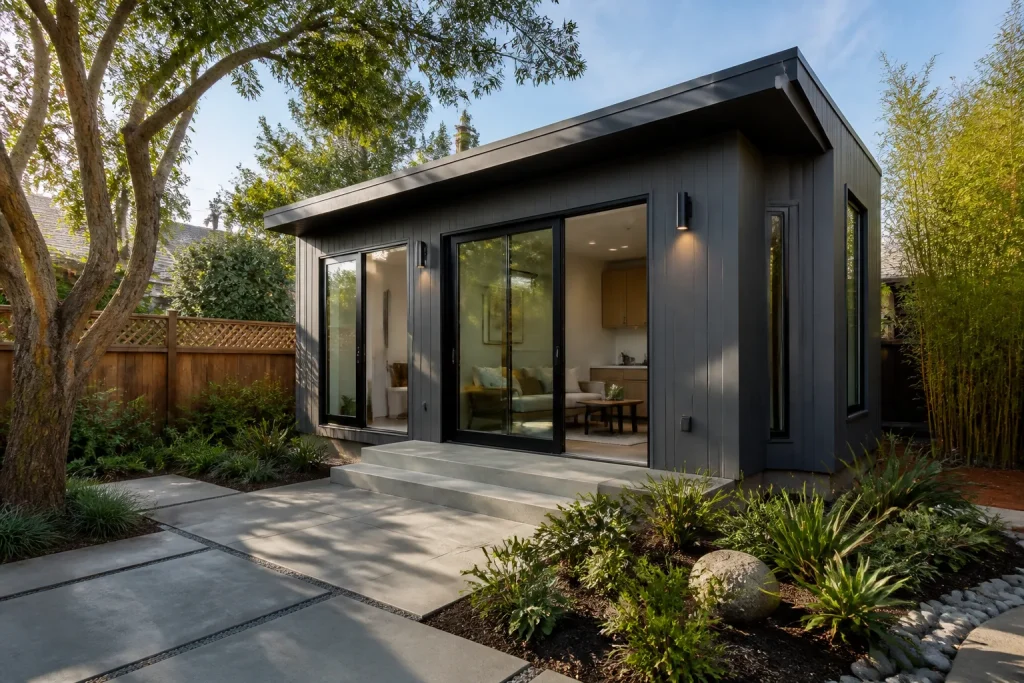
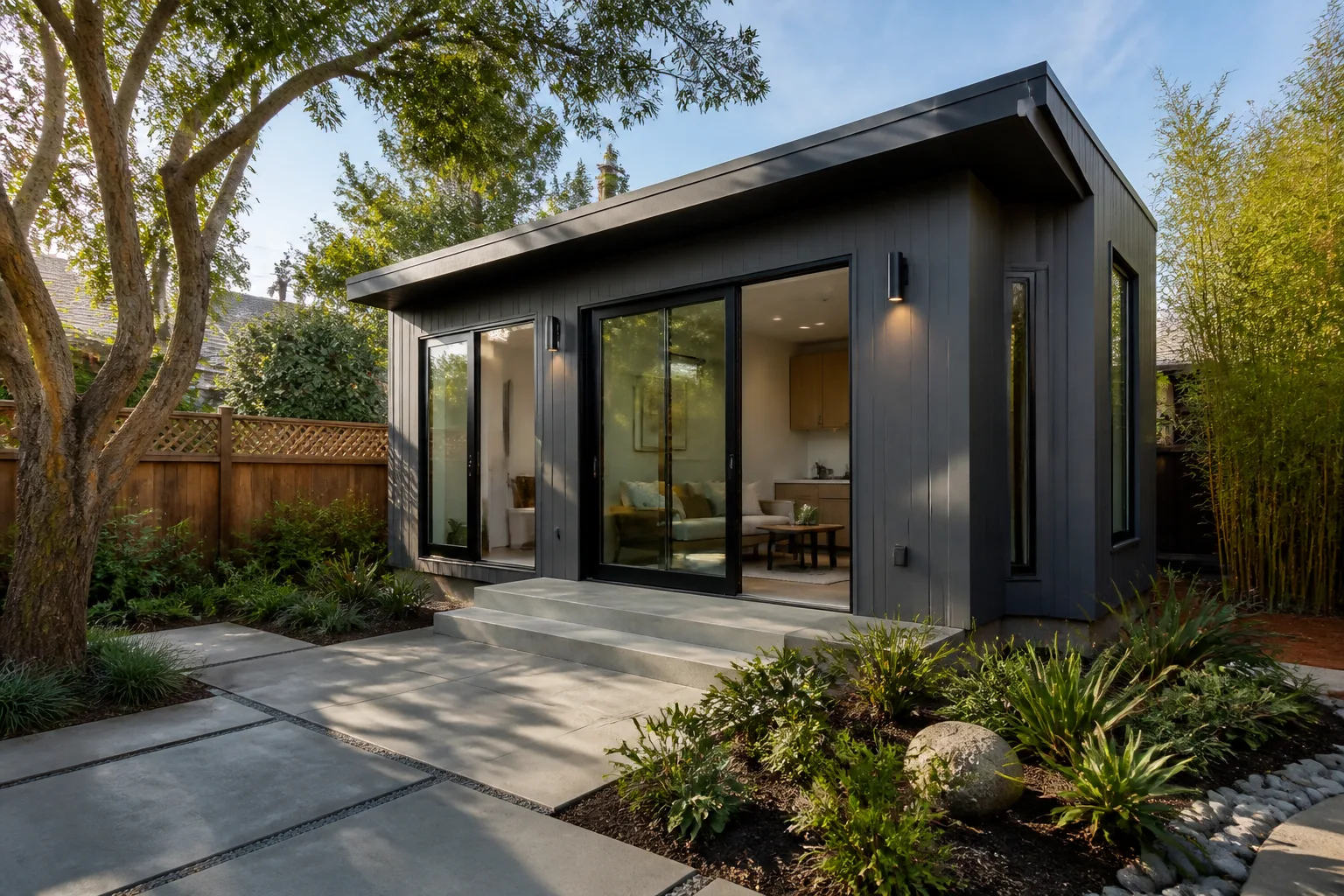
Plant Prefab Home Addition Contractor in Los Angeles: A Homeowner’s Guide
Plant Prefab’s base module prices are real, and they’re only about 40 to 60 percent of what you’ll actually spend by the time the unit is occupied in Los Angeles. The rest is site work, foundation, utility connections, permits, and general contractor fees that vary dramatically by property. This guide breaks down what Plant Prefab covers, what your local GC handles, and what the full cost stack looks like in LA, so you can plan without surprises.
If you’d rather skip the research and get a written price for your specific lot, call (254) 602-5618. We walk Los Angeles properties every week and can tell you within an hour what’s feasible.
Written by Russ Delmar, Owner at Lodgewick ADU Builders, serving Los Angeles since 2010.
Key Takeaways
- Plant Prefab modules start around $250,000 for a one-bedroom unit, but the all-in cost in Los Angeles typically lands between $350,000 and $500,000 once site work, foundation, utilities, permits, and GC fees are included.
- Your local general contractor handles 50 to 60 percent of the total project scope: foundation, site prep, utility connections, crane placement, and LADBS permit coordination.
- LA’s expansive clay soils and hillside grading requirements can add $15,000 to $40,000 to a foundation budget before a single module arrives.
- The factory inspection for Plant Prefab units happens at the plant in Rialto, but Los Angeles still requires full local permits, plan checks, and inspections through LADBS.
- Plant Prefab makes the most financial sense on flat lots with easy crane access. On tight hillside parcels, a site-built addition from a local ADU builder in Los Angeles often comes in at a lower total cost.
What Plant Prefab Actually Covers, and What Your Local GC Has to Handle
Here’s the part most homeowners miss: Plant Prefab is a manufacturer, not a general contractor. They build the modules in their factory in Rialto, California. They do not pour your foundation, pull your Los Angeles permits, trench your utility lines, or place the crane that lifts modules onto the slab. That work falls to the local GC you hire.
In our experience managing prefab installations across Los Angeles neighborhoods, the split looks like this:
| Scope Item | Who Handles It | Typical LA Cost Range |
|---|---|---|
| Factory-built modules (base price) | Plant Prefab | $220,000 – $350,000 for 1 – 2 bedroom units |
| Site prep and demolition (if replacing a garage) | Local GC | $8,000 – $25,000 |
| Foundation and seismic anchoring | Local GC | $25,000 – $65,000 depending on soil and hillside conditions |
| LADBS permits and plan check fees | Local GC coordinates | $3,000 – $8,000 |
| Utility connections (water, sewer, electrical, gas) | Local GC | $10,000 – $30,000 depending on distance from mains |
| Crane rental and placement coordination | Local GC arranges | $6,000 – $15,000 for a typical LA residential street |
| Foundation-to-module crane and set work | Local GC | $5,000 – $12,000 |
| Finishing work: decks, landscape repair, paint touch-ups | Local GC | $5,000 – $20,000 |
| General contractor fee and project management | Local GC | 10 – 20% of total hard costs |
If you’re talking to a contractor about an addition in Los Angeles and they give you a number that matches the Plant Prefab website price, walk away. They’ve left out half the job.
How LA Soil Conditions Change the Foundation Number
Los Angeles is not one soil type. If you live in Sherman Oaks or Studio City, you’re likely on expansive clay that swells when wet and shrinks when dry. In the hills above Silver Lake or Echo Park, you’re dealing with slope stability requirements and potential caisson foundations. In the South Bay and coastal areas, you may hit a high water table or sandy soil that requires over-excavation.
Each condition changes the foundation cost by tens of thousands of dollars. A standard 20×40 slab on grade in the San Fernando Valley might run $25,000 to $35,000. The same footprint on a hillside lot in Mount Washington with caissons and retaining walls can hit $60,000 or more.
This is why a site visit before any pricing conversation is non-negotiable. No honest contractor can price a prefab foundation in Los Angeles from photos. We’ve walked lots in Eagle Rock that looked flat from the street and turned out to have 18 inches of undocumented fill that needed compaction. The foundation price changed by $12,000 that day.
Plant Prefab modules are heavy. A one-bedroom unit weighs 20,000 to 30,000 pounds. That weight transfers to the foundation, so the slab or pier system has to be engineered for point loads at the module’s connection points. A standard ADU foundation won’t necessarily cut it. You need a GC who understands manufactured housing anchoring requirements and will have the foundation plans stamped by a California structural engineer. When we build with Plant Prefab or similar systems, we include that engineering in the written price before work starts.
The LADBS Permit Process for Factory-Built Housing
Plant Prefab units go through a different approval path than site-built additions, but Los Angeles homeowners should not mistake that for a shortcut. The state of California inspects the factory and approves the module plans under the California Department of Housing and Community Development (HCD). That covers what happens inside the factory walls: framing, electrical, plumbing, mechanical.
What HCD does not cover is everything that happens on your land. Los Angeles Department of Building and Safety (LADBS) still requires:
- 1
Site plan approval showing setbacks, lot coverage, and parking requirements specific to your zoning.
- 2
Foundation permit with engineered drawings for the slab or pier system.
- 3
Utility connection permits for sewer lateral, water service, electrical panel upgrade, and gas line if applicable.
- 4
Grading permit if your lot requires cut or fill work, which is common on hillside properties.
- 5
Final inspection after the module is set and utilities are connected.
The HCD factory approval generally speeds up the plan check portion because LADBS is not re-reviewing the module’s internal construction. In practice, a Plant Prefab permit package in Los Angeles runs 4 to 8 months from submittal to issuance, while a fully site-built ADU of similar size runs 6 to 10 months. The time savings is real, but it is not dramatic, and it evaporates if your GC does not know how to present the factory approval documentation to LADBS plan checkers in the right sequence.
One more thing Los Angeles homeowners should know: if your lot is in an HOA like those in Porter Ranch or Playa Vista, the HOA’s architectural review happens before LADBS even looks at your plans. Modular homes face additional scrutiny. We’ve helped homeowners in HOA communities get Plant Prefab units approved, but it required renderings, materials samples, and several meetings. Budget 30 to 60 days for HOA review if it applies to you.
Questions to Ask Any GC About Prefab-Specific Experience
A contractor who has built 40 ADUs site-built may have zero experience with prefab delivery logistics. That experience gap shows up as change orders, damaged modules, and blown timelines. Before you sign anything, ask these questions:
- How many prefab module deliveries have you coordinated in Los Angeles? Crane placement on a narrow street in Highland Park or West Adams is different from a wide suburban driveway. You need someone who has done it.
- Have you managed utility staging for a module delivery? DWP and SoCalGas lines sometimes need temporary relocation or protection while the crane swings a 30,000-pound module overhead. The utility companies have their own timelines and inspection requirements.
- Do you pull HOA approvals for modular structures? If your property is in an HOA, the GC should handle the architectural submission and revision cycles, not leave it to you.
- What’s your process when the module arrives with factory defects? It happens. Paint scuffs, a cracked window, a misaligned door. A good GC documents everything at delivery and coordinates warranty repairs with the manufacturer so the defect does not become your problem.
- Will your written price include crane rental, utility connections, and permit fees? If the answer is anything other than yes, in writing, keep looking.
We’ve been coordinating prefab and modular installations in Los Angeles since 2010 through the Kingswell family of companies. The GCs who do this well treat the factory as a supplier and themselves as the single point of accountability. That’s how we operate. The written price covers everything: foundation, permits, utilities, crane, set, and finish. No change orders at the door.
Plant Prefab vs. Site-Built Addition: When Each Makes Sense in Los Angeles
The honest comparison is not about what Plant Prefab charges for a module. It’s about what the full project costs, how long it takes, and what you get for the money.
When Plant Prefab makes sense:
- You have a flat or gently sloping lot with a clear path for a crane from the street.
- You want a shorter construction timeline. A Plant Prefab unit can go from permit issuance to occupancy in 6 to 9 months, while a site-built addition typically runs 10 to 14 months.
- You value the controlled factory environment. Materials are stored indoors, dimensional tolerances are tighter, and weather delays during framing are eliminated.
- Your lot has minimal access issues. No power lines directly overhead, no trees blocking the crane swing radius, street wide enough for a mobile crane with outriggers.
When a site-built addition from a local ADU builder makes more sense:
- Your lot is a hillside or has significant slope. The foundation costs and crane challenges often erase the prefab savings entirely.
- You have a complex existing structure to tie into, like a 1920s Spanish bungalow in Los Feliz with a foundation that’s settled in three dimensions.
- You need a very specific floor plan. Plant Prefab offers a set catalog of configurations. Customization is limited, and major changes push you into their custom line at custom prices.
- Your neighborhood has narrow streets, low hanging power lines, or tight setbacks that make crane placement impractical. We’ve had projects in Beachwood Canyon where a crane simply would not fit, and site-built framing was the only realistic option.
On a flat standard lot in the San Fernando Valley, the all-in cost of a Plant Prefab one-bedroom unit typically lands between $350,000 and $420,000. A comparable site-built ADU from a local builder in Los Angeles typically runs $280,000 to $380,000. The prefab premium buys you speed and factory quality control. It does not buy you savings on an average lot.
What it should buy you is certainty, and that is where your choice of local GC matters most. Plant Prefab is a genuine partner for the right project, and we recommend them alongside other factory systems we work with. The quality of their modules is solid. But no module manufacturer pours concrete, trenches a sewer line, or argues with a DWP inspector. That’s the work that either makes your project predictable or turns it into a year of headaches.
When to Call a Pro
If you’re at the point where you’re comparing module costs online, you’ve probably already done more research than most homeowners. The next step is getting someone to walk your actual lot. Plant Prefab, Abodu, Cover, and Dvele all make good units, but none of them can tell you what your foundation will cost on your specific Los Angeles parcel. That assessment requires feet on the ground and a GC who has pulled LADBS permits on similar properties.
We’re happy to do that walk-through and give you a written price before any work starts, no strings attached. If you’re in Los Angeles and want to know whether a prefab addition makes sense for your lot, call (254) 602-5618 for a free estimate.
Related services in Los Angeles: garage conversions, ADU construction, and home additions.
The Bottom Line
Plant Prefab builds a good module, and the controlled factory process eliminates a lot of weather and quality variability that plagues site-built work. But in Los Angeles, the module is only part of the bill. Your local GC handles foundation, site prep, utilities, permits, and crane logistics, and that work can cost as much as the module itself.
The single biggest factor in whether a Plant Prefab project succeeds is the contractor you hire to manage the site work. Ask hard questions about prefab delivery experience, get everything in writing, and do not accept a price that excludes the foundation and utilities.
If you’re in Los Angeles and need help thinking through the numbers for your property, Lodgewick ADU Builders offers free estimates, and every price we give is written before any work starts. Call (254) 602-5618 and we’ll walk your lot with you.
Frequently Asked Questions
All-in costs for a one-bedroom Plant Prefab addition in Los Angeles typically run $350,000 to $500,000 depending on lot conditions, foundation requirements, utility distances, and crane access. The base module price is only 40 to 60 percent of that total. Call (254) 602-5618 for a site-specific written estimate, no cost to you.
Yes. The factory inspection through California HCD covers the module’s internal construction, but LADBS still requires site plan approval, foundation permits, utility connection permits, grading permits if applicable, and a final inspection after the unit is set. Plan check timelines run 4 to 8 months in Los Angeles.
Expect 10 to 16 months from first planning conversation to occupancy. That includes 2 to 3 months for design and site evaluation, 4 to 8 months for LADBS permits, 2 to 3 months for site work and foundation, and 1 to 2 weeks for delivery, set, and utility hookup. The module itself goes up fast; the site work and permitting do not.
It should not, if you hire a GC who provides a written price upfront. The Kingswell Guarantee at Lodgewick means every project gets a written price before work begins, with no price changes at the door. If something unexpected surfaces during site work, we address it in writing and agree on any changes before proceeding. Call (254) 602-5618 to schedule a free estimate and see exactly what a written price looks like.
Written by Russ Delmar, Owner at Lodgewick ADU Builders, serving Los Angeles since 2010.
Need ADU Help?
Call Lodgewick ADU Builders - licensed & insured, here with fast after-hours help in Los Angeles.
(254) 602-5618