
Home Addition Contractor Cost Guide: What Los Angeles Homeowners Pay in 2026
Most Los Angeles home additions in 2026 will land between $320 and $480 per square foot, which puts a 500-square-foot addition at roughly $160,000 to $240,000, and a 1,000-square-foot addition at $320,000 to $480,000. Those numbers include design, permits, labor, materials, and the site work that surprises people. The spread is wide for a reason – and if you’d rather talk through your specific project, call (254) 602-5618 and we’ll walk you through it.
The lowest bid on a Los Angeles home addition in 2026 is often $60,000 to $100,000 below the median, not because that contractor is more efficient, but because they’ve excluded line items you won’t notice are missing until you’re mid-project and out of options. We see it every month. Someone signs a contract that looks too good to be true, then discovers the soils report was never in the scope, the panel upgrade is a “change order,” and the landscaping restoration was always going to be extra. This guide explains where that gap comes from so you can compare bids honestly.
What Home Additions Actually Cost Per Square Foot in Los Angeles
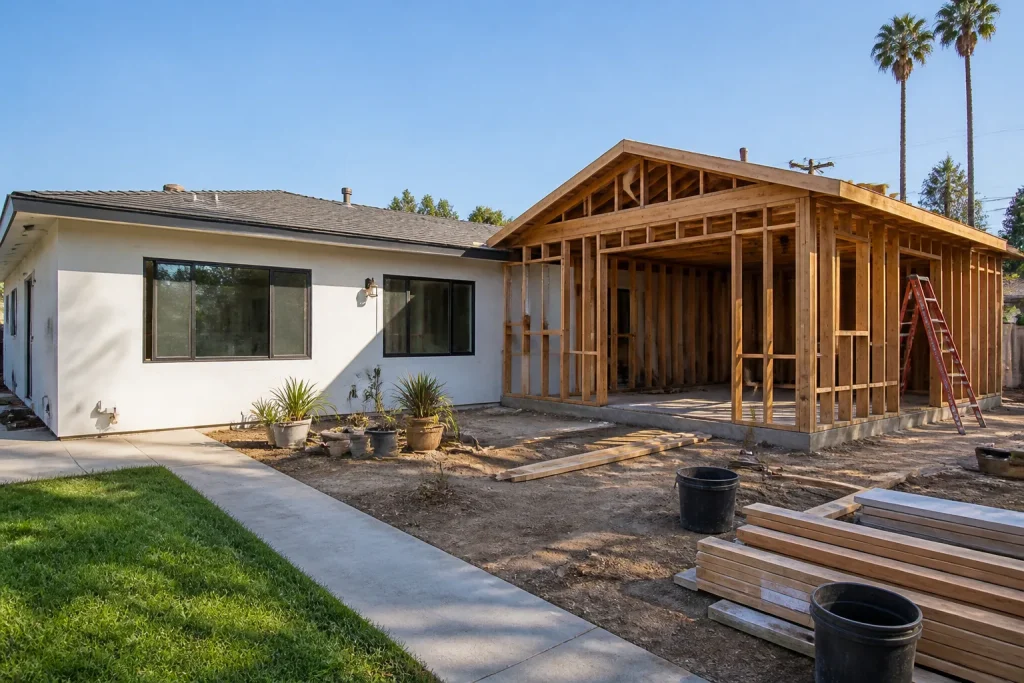
The type of addition you choose drives the per-square-foot number more than any other factor. A single-story bump-out is the least expensive way to add space. A second-story addition is the most expensive. An ADU addition – a detached accessory dwelling unit, which is a small, self-contained house on your existing lot – sits in the middle, but it carries its own set of costs around utility connections and site preparation. Here are the ranges we quote in Los Angeles in 2026:
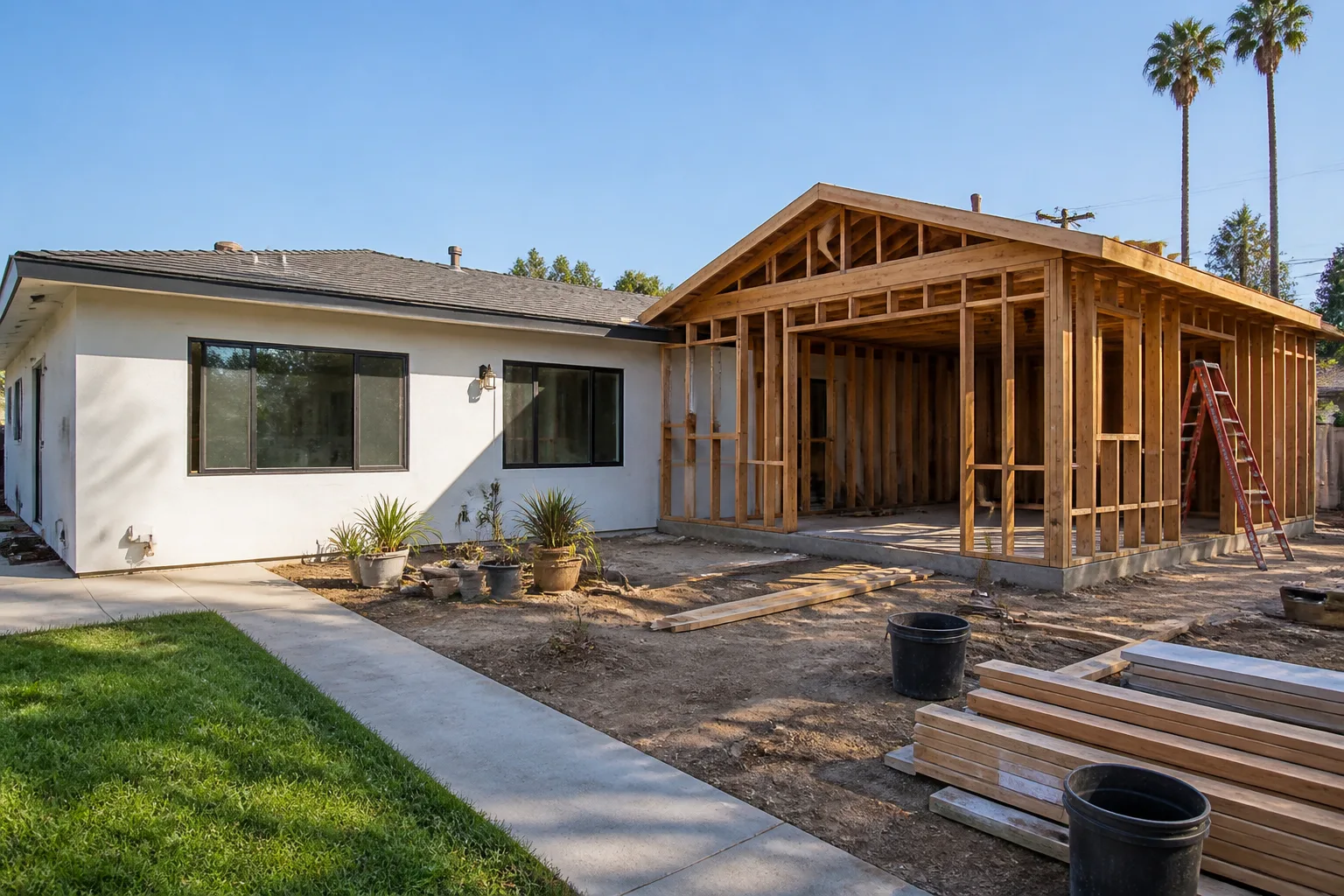
- Single-story attached addition: $320 – $410 per square foot. A 400-square-foot family room or primary suite expansion typically runs $128,000 to $164,000.
- Second-story addition: $380 – $520 per square foot. You’re paying for structural reinforcement of the existing lower level, stair construction, and the complexity of tying into an occupied home. A 600-square-foot second-story addition usually lands between $228,000 and $312,000.
- Detached ADU addition: $340 – $480 per square foot. A 500-square-foot one-bedroom ADU – a small house with its own kitchen, bath, and entrance, built on your lot – typically costs $170,000 to $240,000 in Los Angeles. This includes the separate electrical service or subpanel, sewer or septic tie-in, and the site work that attached additions don’t always need.
Hillside lots in Los Angeles – places like Mount Washington, Echo Park’s steeper pockets, Beverly Glen, or parts of Studio City – add 15 to 25 percent to those numbers. Retaining walls, pier-and-grade-beam foundations, and the extra engineering required for slope stability are real costs that flat-lot builds never see. Coastal zone properties from Pacific Palisades to San Pedro face another layer: stricter structural requirements for wind and salt exposure, plus a review process that can add months before a permit is issued. The Palisades rebuild effort has made coastal engineers and plan checkers harder to schedule in 2026 than at any point in the last decade.
Five Line Items Low Bids Leave Out (And What They Cost When They Show Up Later)
The gap between a low bid and a fair bid on the same Los Angeles project is rarely about labor rates. It’s about scope. When we review competitor contracts for homeowners – something we do during free estimates – we look for these five items first. They’re the most commonly excluded line items in Los Angeles home addition bids, and each one carries a real price tag when it appears mid-project:
- Soils report and foundation engineering: $4,000 – $8,000. Every permitted addition in Los Angeles needs a geotechnical soils report before the foundation can be designed. Low bids skip it because “we’ll see what we find when we dig.” That’s not how Los Angeles building permits work.
- Title 24 energy compliance documentation: $2,500 – $5,000. The state’s energy code requires a certified compliance report for every permitted addition. If it’s not in the contract, it becomes a change order the day you need your permit signed off. More on what Title 24 means for 2026 additions below.
- LADWP panel upgrade: $4,000 – $9,000. Adding 400 to 1,000 square feet almost always pushes an older Los Angeles electrical panel past its capacity. A 100-amp panel from the 1960s won’t carry a new addition’s load. Upgrading to 200 amps is common; 400 amps isn’t unusual for larger projects.
- Temporary housing during construction: $0 – $25,000+. If your addition makes your kitchen or only bathroom unusable for six weeks, someone’s moving out. Contractors never include this. Homeowners discover it the week before demo.
- Landscaping and site restoration: $3,000 – $15,000. Trenches for utilities, equipment access, and material staging destroy yards. The low bid ends at the finished drywall. The irrigation repair, sod replacement, and fence reconstruction are on you.
We pulled a contract review out in Eagle Rock last month where the missing items added up to $47,000 – on a bid that was advertised as “$35,000 under everyone else.” The math on that worked out to a $12,000 premium over the fair bid, once the excluded work went back in. And the homeowner had to manage the discovery process themselves, one surprise at a time.
What 2026 Title 24 Rules Mean for Your Addition’s Cost
California’s Title 24 energy code updates every three years, and the cycle affecting Los Angeles additions in 2026 is the one that took effect January 1, 2026. For home additions, the practical impact comes down to three things, and all three show up as real line items:
- EV-ready outlets: New detached ADUs and additions that include a garage or carport must be wired as EV-capable. That’s a 240-volt circuit, a dedicated breaker, and often a subpanel upgrade – roughly $1,500 to $3,500 if it’s planned from the start, and double that if it gets retrofitted after inspection fails.
- Solar-ready wiring: Additions over a certain roof area need conduit and structural provisions for future solar installation. The wiring itself is inexpensive – $800 to $2,000 – but it requires engineering notes on the plans and careful sequencing during framing. Contractors who don’t build to current code get caught at pre-drywall inspection, and that delay costs weeks, not just dollars.
- Heat pump water heater mandates: In most Los Angeles climate zones, natural gas water heaters are no longer an option in new construction or additions. Heat pump water heaters cost $3,000 to $6,500 installed, versus $1,200 to $3,000 for the traditional gas unit. They also need a 30-amp circuit and sometimes more physical space than the old tank occupied. Planning for this at design stage saves money. Discovering it at rough-in costs more.
The Los Angeles Department of Building and Safety enforces Title 24 on every permitted addition, and the 2026 code cycle comes with stiffer penalties for non-compliant work. A contractor who says “we’ll handle it during construction” is the same contractor who’ll hand you a change order for it later. We put Title 24 compliance in the written price, on paper, before work starts – along with everything else, because that’s the only way a fixed price means anything.
Fixed-Price vs. Cost-Plus: Which Contract Protects You in Los Angeles
A fixed-price contract says the number on page one is the number you pay, unless you change the scope. A cost-plus contract says you pay the actual cost of labor and materials, plus a set percentage for the contractor’s overhead and profit. In Los Angeles, fixed-price makes more sense for most homeowners, most of the time. Here’s the breakdown:
- Fixed-price protects you when: The project is well-defined (a standard room addition, a garage conversion, a spec ADU), the site is accessible, and you’re not expecting to make design changes mid-build. The contractor carries the risk of cost overruns, and you’re protected from the $80,000 spread problem.
- Cost-plus protects you when: The site is complicated – think hillside, difficult access, or an older Los Angeles home where the framing condition is unknown until walls open up. In those cases, a fixed price forces the contractor to pad the number to cover unknowns, and you might pay more than the actual cost. A fair cost-plus contract includes open book accounting and a not-to-exceed cap.
We use fixed-price for most of our Los Angeles projects, and here’s the part to watch for: a fixed price is only worth the paper it’s written on if the scope is complete. Ask any bidder three questions before you sign. What line items are excluded from this price? Who carries the cost if the soils report requires a deeper foundation? And what happens if the plan checker requires changes? If the answers aren’t in writing, you’re in a cost-plus contract wearing a fixed-price costume. Every Lodgewick project comes with a written price before work begins – line items included, exclusions listed, no price changes at the door – and that commitment is part of the 365-Day Done Right Promise we put in writing on day one.
Post-Fire Labor Market in Los Angeles: What’s Actually Hard to Schedule in 2026
The Palisades and Eaton fires changed construction labor in Los Angeles in ways that will ripple through 2026 and beyond. The rebuild effort has absorbed thousands of skilled workers across specific trades, and that affects your addition’s timeline even if your home is nowhere near a burn zone. Here’s what we’re seeing on the ground:
- Concrete and foundation crews are the tightest trade in Los Angeles right now. Every rebuild starts with a foundation, and the volume of slab and footing work across the Palisades and Altadena is unprecedented. Flatwork crews that used to book two weeks out are now six to ten weeks out. If your addition needs a new slab or a significant foundation, expect your project’s schedule to bend around concrete availability.
- Electricians are the second bottleneck. The LADWP panel upgrade and service relocation work required for fire rebuilds overlaps with the same electricians who do EV circuits, heat pump water heater tie-ins, and whole-home rewiring for additions. A 200-amp panel upgrade that took two weeks to schedule in 2023 now takes four to eight.
- Framers are more available, but not by much. Rebuild framing has drawn crews toward the coast and Altadena corridor, leaving pockets of the San Fernando Valley and South Bay with longer waits. If you’re in Encino, Tarzana, or Torrance, you may wait longer for a framing crew than you would have two years ago.
What this means for your project start date: a realistic Los Angeles home addition timeline in 2026 is 10 to 14 months from signed contract to move-in, with 3 to 5 of those months in design, engineering, and permitting before ground breaks. Contractors promising to start next week are either not busy, which is its own red flag, or they haven’t actually secured their subs. Ask a contractor to name their concrete sub and electrician. If they can’t, assume the schedule they gave you is aspirational.
When to Call a Pro (and What “Done Right” Looks Like)
A home addition is not a weekend project, and in Los Angeles, it’s not a handyman project either. Anything that changes the footprint of your home, adds square footage, or moves structural walls requires a building permit from the Los Angeles Department of Building and Safety, structural engineering, and a contractor who carries the right Los Angeles licenses. Unpermitted addition work in Los Angeles is discovered at resale, and the cost to legalize it then is far higher than doing it right the first time – assuming it can be legalized at all.
Done right in Los Angeles means a written price before work starts, a defined arrival window when crews show up, a job site that gets cleaned up daily, and a written guarantee that says what happens if something fails after move-in. That’s what The Kingswell Guarantee covers on every Lodgewick project, and it’s what the 365-Day Done Right Promise puts in writing: if it’s not done right, we come back and make it right, free of charge, inside the guarantee period. We work with materials and systems we know hold up in Los Angeles – including prefab options from Boxabl, Plant Prefab, Tuff Shed structures for simpler builds, and James Hardie siding for the fire-hardening that Los Angeles homeowners are asking about after the last two fire seasons. A lodge, after all, is a small house on a larger property – which is exactly what an addition becomes.
Related services in Los Angeles: Home Addition Contractor in Los Angeles · Garage Conversion Contractor in Los Angeles · ADU Builders in Los Angeles
The Bottom Line
Los Angeles home additions in 2026 cost between $320 and $480 per square foot, with hillside and coastal zone premiums on top, Title 24 compliance adding $5,000 to $15,000 in required systems, and post-fire labor shortages stretching timelines in specific trades. The gap between the lowest bid and a fair bid on the same project can be $60,000 to $100,000 – and it’s almost always explained by excluded line items, not better efficiency. When you compare bids, ask what’s excluded. Ask who their electrician is. Ask what happens when the soils report comes back worse than expected. Get every answer in writing.
If you’re in Los Angeles and planning a home addition, Lodgewick ADU Builders offers free estimates with a written price before any work starts – call (254) 602-5618 to schedule yours. Russ Delmar will walk the property with you, talk through what your specific lot needs, and leave you with a number on paper you can plan around.
Frequently Asked Questions
A 500-square-foot addition in Los Angeles typically costs $160,000 to $240,000 in 2026, or $320 to $480 per square foot depending on the addition type. Single-story attached additions trend toward the lower end at $320 – $410 per square foot. Detached ADUs run $340 – $480 per square foot. Hillside lots add 15 to 25 percent regardless of type. Call (254) 602-5618 for a written estimate on your specific project.
Most of the gap between a low bid and a fair bid in Los Angeles comes down to excluded scope, not better pricing. Low bids commonly leave out the soils report, Title 24 compliance documentation, the LADWP panel upgrade, and landscaping restoration – then charge for them as change orders mid-project. That spread can reach $60,000 to $100,000 on the same addition. Compare bids by asking what’s excluded, in writing.
We’re not expecting meaningful price relief in Los Angeles in 2026. Post-fire demand for concrete, electrical, and framing labor is keeping those trades expensive, and the 2026 Title 24 code cycle added compliance costs to every permitted addition. Lumber and concrete pricing has been volatile for three years without sustained softness. If you have a project planned, the current pricing environment favors locking in a fixed-price contract now rather than waiting for a downturn that may not come.
Yes, a garage conversion in Los Angeles typically costs less than a ground-up addition because the structure, roof, and foundation already exist. A 400-square-foot garage conversion often runs $140,000 to $220,000 in 2026, compared to $128,000 to $164,000 for a comparably sized attached addition – but the conversion price includes things the addition doesn’t, like bringing the slab up to habitable code and upgrading the existing walls. For details on what conversion costs cover, see our page on garage conversions in Los Angeles or call (254) 602-5618.
Written by Russ Delmar, Owner at Lodgewick ADU Builders, serving Los Angeles since 2010.
Need ADU Help?
Call Lodgewick ADU Builders - licensed & insured, here with fast after-hours help in Los Angeles.
(254) 602-5618