
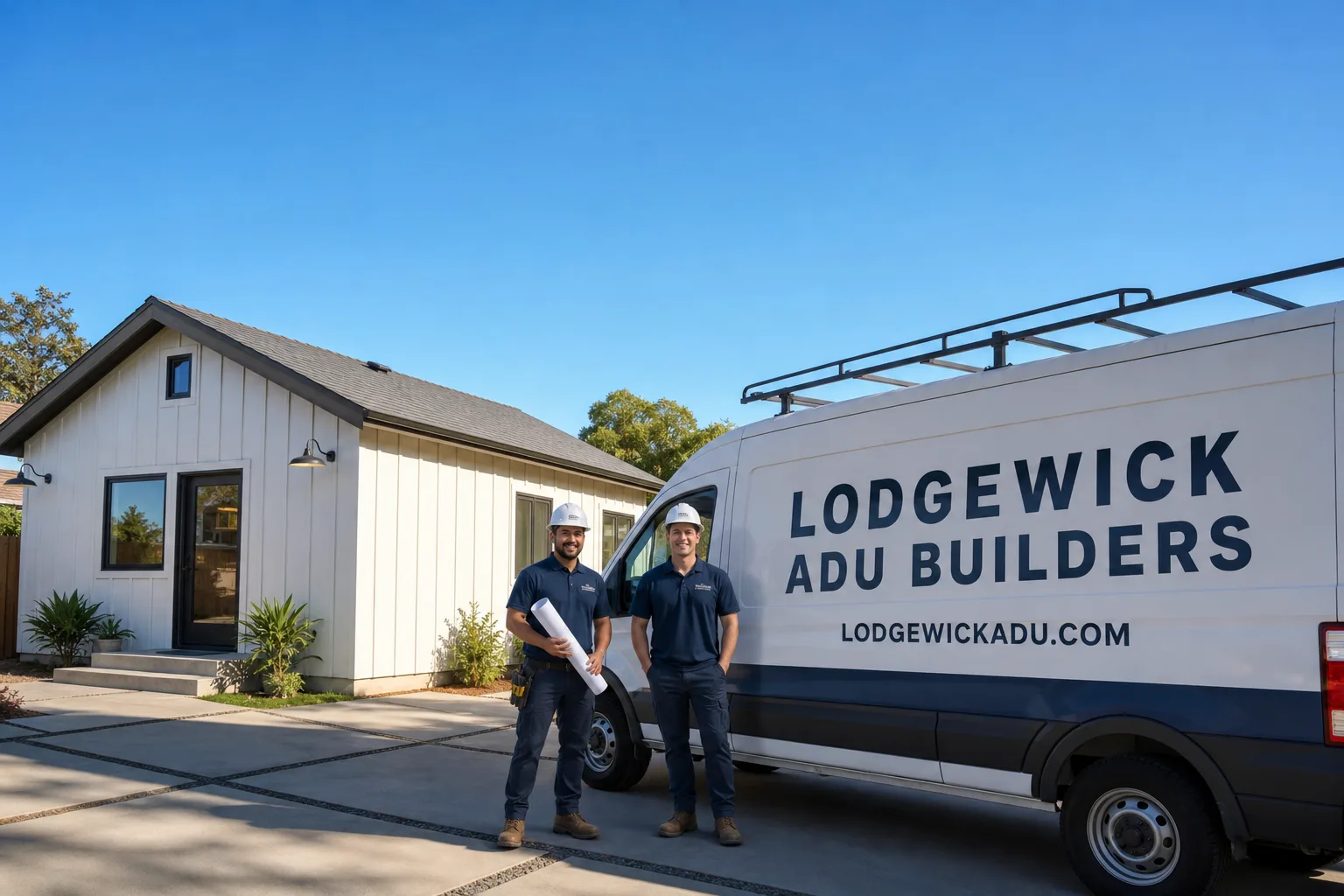
Fast, Reliable Garage Conversion Contractor Across Hollywood
Garage conversion in Hollywood typically runs $140,000 – $260,000 for a completed ADU, with high-end hillside and Hollywoodland projects pushing past $300,000 once fire-hardening, geotechnical work, and custom finishes are factored in. Most flatland alley-garage conversions land between $150,000 and $220,000, and the permitting process here is genuinely two-track: flatland projects clear city review in roughly 3 – 5 months, while Hollywood Hills parcels under the Very High Fire Hazard Severity Zone add Chapter 7A compliance and soils reports that routinely add $25,000 – $45,000 before framing begins. If you’re weighing a garage conversion anywhere from Franklin Village to Beachwood Canyon, call (254) 602-5618 and we’ll give you a written price before you commit to anything.
Why Lodgewick ADU Builders Is Hollywood’s Preferred Garage Conversion Contractor Company
We’ve built enough garage conversions across Hollywood to know that the neighborhood’s permitting reality doesn’t match what most online guides describe. The flatlands around Sunset and Santa Monica Boulevards are full of 1920s – 1940s Spanish Colonial and Craftsman bungalows with rear alley garages, and those projects move differently than a hillside lot off Cahuenga or Beachwood Drive. Russ Delmar, who leads our Hollywood builds, has steered crews through both tracks enough times to flag a Hollywoodland HOA design review or a Chapter 7A cladding requirement before it becomes a change order. That’s the local knowledge that keeps a project from stalling mid-permit.
Our Hollywood customers get the same written commitments as every Lodgewick job: a fixed price before work starts, a defined arrival window for every crew day, and the 365-Day Done Right Promise in writing. If something isn’t right within a year of completion, we come back and make it right. No phone tag, no re-quote, no argument. The conversation about your garage conversion starts with a real number, not a vague ballpark that shifts after the first inspection.
Garage Apartment Conversion in Hollywood
A garage apartment conversion in Hollywood turns an existing detached or attached garage into a rentable or family-occupancy dwelling unit with its own kitchen, bath, and separate entrance. On a 1920s Spanish Colonial with a rear alley garage in the flatlands, this usually means reframing the interior, upgrading the 60-amp panel to 200 amps, replacing galvanized supply lines, and adding insulation plus a mini-split HVAC system. The finished unit typically lands between $150,000 and $220,000, though custom millwork, architectural glazing, and steel-framed doors push the top end well past that.
What surprises most Hollywood homeowners is that the garage itself is rarely the constraint. It’s the service infrastructure feeding it. The original galvanized lines and undersized panels in pre-war Hollywood bungalows were never sized for a second dwelling, and LA’s moderately hard water has spent decades corroding those pipes. We plan for the full panel and supply-line replacement from day one, so the price you sign is the price you pay.
Detached Garage to Rentable Unit
Detached garage conversions in Hollywood’s alley-served flatlands are the most common project type we see. The garage is already separated from the main house, which simplifies fire separation and noise isolation. The tradeoff is that running new sewer, water, and electric from the street or main dwelling across the rear yard adds $15,000 – $30,000 that an attached-garage project usually avoids.
Hillside Garage Apartment Conversions
On Hollywood Hills lots, a garage apartment conversion is a fundamentally different build. The Very High Fire Hazard Severity Zone designation means the structure itself must meet Chapter 7A standards: non-combustible cladding, ember-resistant vents, and multi-pane glazing. Then there’s the geotechnical review. Hillside-adapted foundations and aging retaining walls require a soils report before the city will even accept the permit package, and that report often dictates foundation upgrades before any framing starts.
Garage Conversion Permit in Hollywood
A garage conversion permit in Hollywood is the city-issued approval that lets you legally convert garage square footage into habitable dwelling space, and it runs between $8,000 and $20,000 in city fees, plan-check costs, and school and utility impact fees depending on the scope. Flatland projects in the 90028 and 90038 zip codes typically clear in 3 – 5 months if the plans are clean. Hillside projects under the Very High Fire Hazard Severity Zone designation around the 90068 zip code add Chapter 7A fire-hardening review, geotechnical and soils submissions, and haul-route permits that routinely extend the timeline to 6 – 9 months and add $25,000 – $45,000 in hard costs before a single permit is issued.
That’s the split most online guides miss: the same zip code can mean two entirely different permitting tracks. A garage conversion off Fountain Avenue in the flatlands shares almost nothing procedurally with one off Mulholland Drive, even though both are “Hollywood.” We prepare both packages, but we never quote one based on the other.
Flatland Permit Path
Garages behind Spanish Colonial and Craftsman bungalows on Hollywood’s street grid usually convert under standard ADU provisions. The city checks setbacks, utility connections, and habitability standards. The permit itself rarely becomes the bottleneck. The bottleneck is the plan set reflecting the actual conditions: if the original 60-amp panel isn’t addressed in the drawings, plan check sends it back, and the homeowner loses 3 – 4 weeks.
Hillside and Hollywoodland Permit Path
Hillside parcels add layers flatland projects never touch. Chapter 7A compliance is non-negotiable, and the Hollywoodland Homeowners Association still exercises private architectural review over exterior cladding, window profiles, and rooflines despite AB 3182 preempting its historic ban on ADUs. An out-of-area contractor who doesn’t know that will watch a permitted project stall at the HOA review stage. We file city and HOA submissions in parallel from day one.
Trusted Brands We Service in Hollywood
We install and finish units from Abodu, Cover, and Dvele, and we stock James Hardie cladding for Hollywood jobs that need a fire-rated or period-appropriate exterior. For a hillside build under Chapter 7A, Hardie’s non-combustible fiber cement boards clear fire review without sacrificing the look of a 1920s hillside home. For flatland alley-garage conversions where the client wants a prefab core to cut framing time, we coordinate the factory order, foundation, and on-site finish work as one schedule. Parts and material availability are localized, so we don’t quote a Hollywood job assuming Bay Area lead times.
Common Garage Conversion Contractor Problems We See in Hollywood Homes
- Quoting a hillside build from a flatland budget. Chapter 7A fire-hardened construction, geotechnical reports, and haul-route permits on Hollywood Hills parcels add $25,000 – $45,000 that a flatland project never incurs. Homeowners who get a flatland-based quote are blindsided when the city rejects the permit package, and the price quietly climbs.
- Scheduling around labor instead of lead times. The custom rift-oak millwork, steel-framed architectural glazing, and specialty door packages common on Hollywoodland and hillside conversions run six to twelve weeks from order. Ordering them after permit issuance means the framing crew finishes and then everyone waits, pushing the move-in date months past what was promised.
- Missing the Hollywoodland HOA design review. Even with city permit in hand, a garage conversion in the 1920s Hollywoodland tract still has to clear the homeowners association’s private architectural committee for exterior cladding, window profiles, and rooflines. Contractors who treat the city permit as the final approval get stopped mid-build.
- Ignoring the original 60-amp panel and galvanized lines. Pre-war Hollywood garages were never wired or plumbed for habitation, and LA’s moderately hard water has spent decades corroding the galvanized supply lines. Skipping the panel and supply-line upgrade to save money guarantees a failed inspection or, worse, a finished unit that can’t run a kitchen and mini-split at the same time.
Pricing for Garage Conversion Contractor in Hollywood, CA
Here are the ranges we quote for Hollywood work, written plainly:
- Flatland alley-garage ADU conversion: $150,000 – $220,000 for a standard one-bedroom unit with kitchen, bath, and separate entrance.
- Hillside garage conversion under Chapter 7A: $190,000 – $280,000 for the same unit, plus $25,000 – $45,000 in fire-hardening and geotechnical costs.
- Hollywoodland garage conversion with HOA design review: $180,000 – $260,000, with the HOA path adding 4 – 8 weeks to the schedule rather than a fixed dollar amount, though cladding upgrades to satisfy both Chapter 7A and the architectural committee can add $10,000 – $20,000.
- Attached garage to living space (no kitchen): $80,000 – $140,000, depending on whether you’re adding a bathroom and how much structural work the original garage needs.
Every one of those numbers gets fixed in writing before we order materials. The price you sign is the price you pay. If you’re budgeting a garage conversion in Hollywood and want an exact number for your lot, call (254) 602-5618. The estimate is free, and it’s a line-item written quote, not a handshake range.
We Also Serve Cities Near Hollywood
Our Garage Conversion Contractor crews work across the Hollywood area daily, and we regularly take on projects in Los Angeles, Long Beach, Anaheim, and Riverside. If you’re in one of those cities and weighing a garage conversion, the same written-price-before-work and 365-Day Done Right Promise apply. For Hollywood homeowners specifically, our Garage Conversion Contractor in Hollywood team knows the local permit split cold, which saves you months of back-and-forth.
Serving Hollywood, CA - Our Local Coverage Area
We’re based in the Hollywood area and know this community well. Use the map below to see our service coverage - if you’re nearby, we can almost certainly help.
FAQs About Garage Conversion Contractor in Hollywood
Yes, and in most of Hollywood’s flatland grid the detached alley garage is the single best ADU candidate on the property because it’s already a separate structure with its own footprint. The caveats are the original 60-amp panel, galvanized supply lines, and sewer connection, all of which typically need full replacement. On a 1928 Spanish Colonial off Glen Holly Drive, we converted a detached alley garage into an ADU and hit exactly that wall: the panel and supply lines had to come out, and the client’s architect had already selected a custom rift-oak millwork package and steel-framed architectural glazing with a six-week lead. We fixed the price in writing before either was ordered, so the schedule was driven by cabinetry and glass arrivals, not by our framing crew. Call (254) 602-5618 if you want a written price for your specific alley garage.
The Very High Fire Hazard Severity Zone designation above the flatlands. Chapter 7A compliance requires non-combustible cladding, ember-resistant vents, and multi-pane glazing, and the city also demands geotechnical and soils reports before accepting the permit package. Those two items alone add $25,000 – $45,000 that a flatland Hollywood project never touches, and the haul-route permits for getting materials up narrow hillside streets add further cost and schedule time. If you’re comparing quotes, make sure the hillside quote actually names Chapter 7A in writing. Ours always does.
Yes. AB 3182, effective in 2021, preempted the Hollywoodland Homeowners Association’s historic CC&R ban on additional dwelling units, but the association still asserts private architectural-review authority over any new structure’s exterior. That means cladding, window profiles, and rooflines have to clear a separate HOA design committee even after the city issues the permit. Flatland Hollywood projects have no equivalent layer. Contractors who miss this discover it after permit issuance, and the client’s chosen exterior materials get rejected. We file the city and HOA submissions in parallel, which is the only way to keep the schedule honest.
Because the custom millwork, architectural glass, and specialty steel door packages common on Hollywoodland and hillside conversions run six to twelve weeks from order, and you can’t rush a cabinetmaker or a glazing fabricator. If those items are ordered after permit issuance, the framing crew finishes and then the job sits waiting on materials. Ordering them the day the permit is issued, or earlier when the client’s designer has already made selections, puts the long-lead items on the critical path where they belong. We write the schedule around material arrivals, not labor availability, and we fix the price before we place those orders.
The price is written before any work starts, based on a line-item scope that covers the specific permit track, the specific long-lead materials, and the specific site conditions. No change orders at the door, no re-quote after the first inspection. That’s the whole point of the written quote: you know the number before you commit, and the number doesn’t move because we discovered something we should have known. Call (254) 602-5618 for a free written estimate on your Hollywood garage conversion.
Written by Russ Delmar, Owner at Lodgewick ADU Builders, serving Hollywood.