
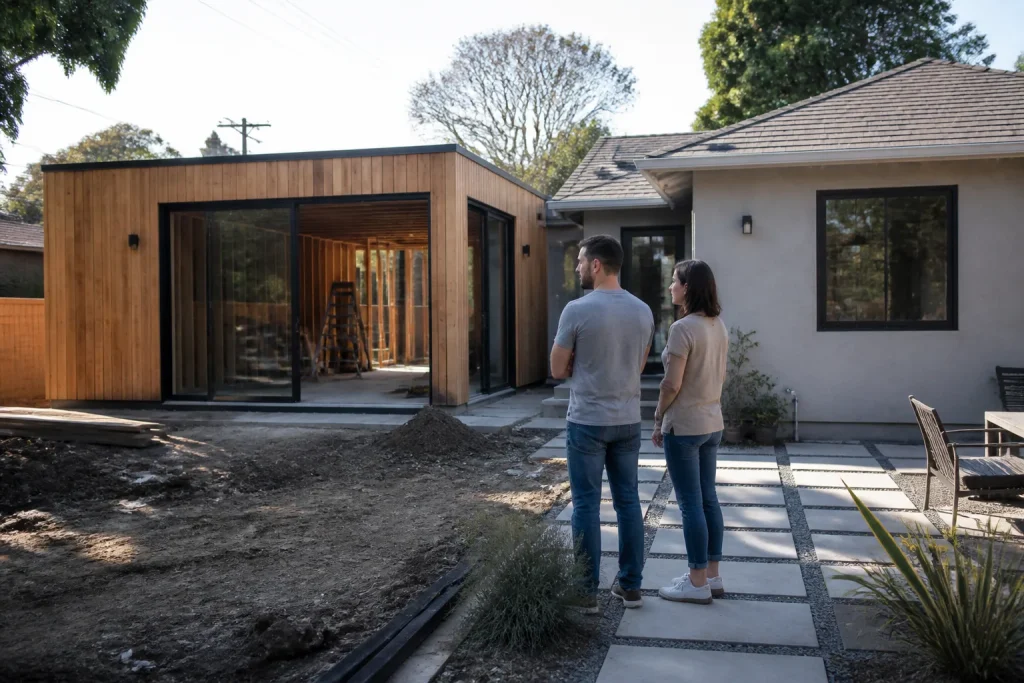
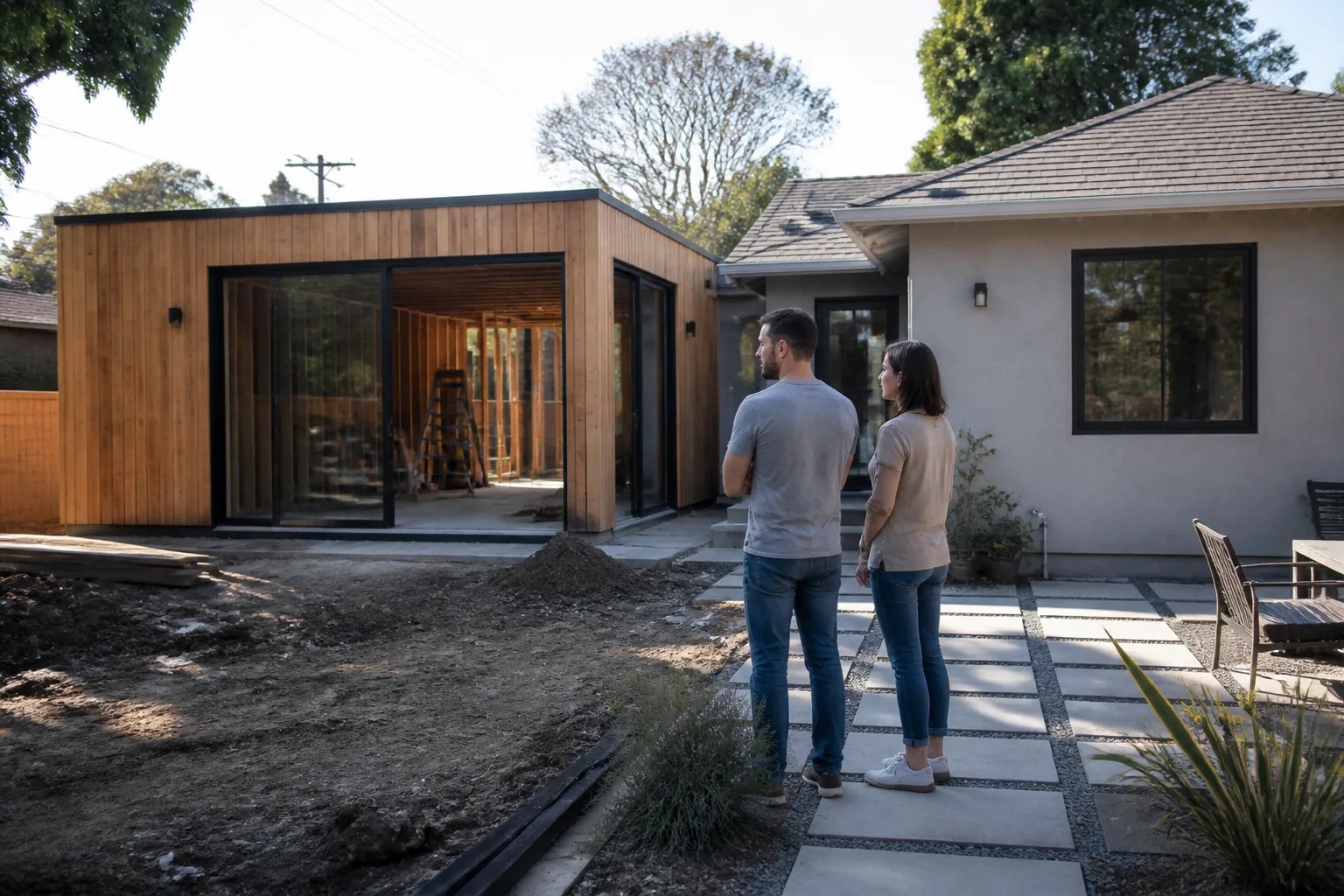
Home Addition Contractor: Repair or Replace? How Los Angeles Homeowners Decide
If your home addition has problems, the repair-versus-replace decision usually comes down to one thing: whether the original work was permitted. A permitted addition with a single failing system (a roof tie-in, a foundation crack, one bad electrical run) is almost always worth repairing. An unpermitted addition with multiple hidden defects usually costs more to fix than to tear out and rebuild. If you’d rather not sort through building records yourself, call us at (254) 602-5618 and we’ll walk you through it.
The $15,000 Quote That Turned Into a $70,000 Gut Job
We got called out to a house in Sherman Oaks last spring. The homeowner had a 400-square-foot family room addition built in 2008. The contractor who did it quoted $15,000 to fix a sagging roofline and some water stains on the ceiling. When we opened the wall, the problems multiplied fast. No permit on file with LADBS. No insulation in the exterior walls. Wiring that looked hand-spliced with electrical tape. The roof tie-in had been flashing-free and underlayered incorrectly, so water had been getting in for years. That $15,000 repair became a $70,000 teardown and rebuild.
This happens more often than you’d think in Los Angeles. A lot of additions built between 1990 and 2015 went up without permits because the owners figured they’d sell before anyone noticed. Now those homes are changing hands, inspectors are flagging the square footage, and the new owners are stuck with a choice: patch it quietly, or do it right. This guide is for anyone facing that decision.
Repair vs. Replace: The Three-Question Test
Before you call a Home Addition Contractor in Los Angeles to look at your problem addition, ask yourself three questions. The answers will point you in the right direction 90% of the time.
- Was it permitted? If yes, and the problem is isolated (one leak, one crack, one outlet flickering), repair is usually the economical choice. If no permit exists, any substantial repair will likely require bringing the whole addition up to current code, which often costs more than a fresh build.
- How many systems are failing? One failing system is a repair. Two or more (foundation and roof, electrical and moisture) usually means the original work was done wrong from the start. Rebuilding is often cheaper per square foot than remediating multiple failures.
- What’s the cost threshold? In Los Angeles, if repair quotes for an existing addition exceed roughly 55 – 60% of the cost to demo and rebuild to current code, replacement wins. That’s the number we use with homeowners evaluating both paths.
Three Scenarios Where Repair Is the Right Call
Repair makes sense when the addition’s structure is sound and the problem is specific. Here are the most common repair-worthy situations we see in Los Angeles.
1. Cosmetic or finish failures on a permitted addition
Drywall tape cracking, worn flooring, outdated windows, peeling exterior paint, a roof shingle or two blown off. If the addition was permitted and passed inspection when it was built, these are normal wear items. Fix them and move on. Replacing a perfectly good addition because the drywall seams show is throwing money away. Expect to spend $3,000 to $12,000 on typical cosmetic repairs in LA, depending on size and finish level.
2. A single-system failure with no water damage
A roof tie-in that leaks only at the flashing, a furnace that died, an electrical panel that’s maxed out. These are isolated problems. A good contractor fixes the failed component without touching the rest of the structure. Roof tie-in flashing repairs in Los Angeles typically run $1,800 to $4,500. A panel upgrade on an addition runs $2,500 to $5,000 depending on amperage and panel location.
3. Foundation settling that hasn’t affected the frame
Some settling is normal in LA, especially in neighborhoods like Woodland Hills or Northridge where soil composition varies block to block. If a foundation inspection shows minor settling that hasn’t twisted door frames or cracked the framing, slab jacking or piering can fix it for $4,000 to $12,000. That’s a fraction of the cost of rebuilding. But if the settling has moved the frame, skip ahead to the replacement section.
Three Scenarios Where Replacement Is Cheaper Long-Term
Replacement is the right call when the original work was defective from the start, unpermitted, or structurally compromised. Here’s when tearing it out beats patching it.
1. The addition was never permitted
This is the big one. In Los Angeles, any addition over 120 square feet generally requires a building permit from LADBS. If yours doesn’t have one, any repair that requires opening walls, moving electrical, or touching structure will trigger a permit, and the inspector will make you bring everything up to current code: ceiling height, egress windows, electrical, insulation, HVAC. You end up rebuilding the addition inside the addition’s columns. At that point, demolition and a clean rebuild is usually less expensive and produces a better result. Unpermitted addition remediation in LA often lands between $50,000 and $120,000 depending on condition, while a clean rebuild of the same footprint might run $250 to $400 per square foot.
2. Water damage has been active for years
By the time water damage is visible on the interior, it’s usually been working for months or years inside the wall cavities. That means rot in the framing, mold in the insulation, corroded electrical connections, and compromised sheathing. We’ve opened walls in LA additions where the bottom plates crumbled like stale crackers. When the framing is compromised, you’re not repairing walls; you’re rebuilding them. A gut-and-reframe on a water-damaged addition commonly ranges from $40,000 to $80,000, not including finishes.
3. Foundation failure has moved the frame
If doors stick, windows won’t open, floors slope more than an inch over eight feet, or the addition is visibly separating from the main house, the foundation has failed. Patching drywall or re-hanging doors won’t fix it. Foundation replacement on an addition in Los Angeles typically runs $25,000 to $60,000 depending on access and slope, plus the cost of reframing whatever the settling damaged. When you hit that price point on an older addition, a full rebuild starts to look financially comparable, and you get a new foundation with fresh seismic anchoring as part of the deal.
How to Check if Your Addition Was Permitted in Los Angeles
This is the first thing we do on any repair-or-replace assessment, and you can do it yourself before you ever call a contractor. Los Angeles building records are public.
- Go to the LADBS website. The Los Angeles Department of Building and Safety maintains an online Building Records search portal.
- Enter your address. You’ll see a list of permits ever pulled on the property. Look for a permit that matches the addition’s construction date and scope (room addition, addition, alteration).
- Check for a Certificate of Occupancy. A permit without a final inspection and Certificate of Occupancy means the work was never signed off. That’s a red flag.
- Request records if nothing shows up. Some older records aren’t digitized. You can submit a public records request through LADBS. Records from the 1970s and earlier often require a manual search.
If there’s no permit and no Certificate of Occupancy, treat the addition as unpermitted. A buyer facing this after a sale may have legal recourse against the seller if the addition’s unpermitted status wasn’t disclosed, but that’s a separate conversation for a real estate attorney. For the purposes of repair-versus-replace, just know: unpermitted work changes everything.
Why “Just Fixing It Quietly” Usually Makes Things Worse
We hear it a lot. “Can’t you just patch the roof and not tell anyone?” A few honest truths about that approach in Los Angeles.
Building departments notice unpermitted additions when a property changes hands, when a neighbor files a complaint, or when aerial imagery shows a structure that doesn’t match the tax roll. Contractors who agree to do unpermitted repairs on an unpermitted addition put you in a worse legal position: now you have unpermitted repair work on top of unpermitted original construction. If an insurance claim ever involves that addition (fire, water damage, earthquake), the insurer will investigate the permit history, and denied claims in these situations are common.
Worse, doing work without a permit in LA can result in stop-work orders and penalties that double or triple the cost of the original repair. The “quiet fix” is almost never quiet, and it’s almost never the cheaper path once discovered. The Kingswell Way is simple: say the price first, get the permits, do the work, leave the job site cleaner than we found it, and put the guarantee in writing. That’s the approach that actually protects a homeowner.
What a Good Repair Assessment Looks Like
If a contractor gives you a repair quote without looking at the foundation, the attic, the crawl space, and the roof tie-in, they’re guessing. A proper assessment on a problem addition in LA takes two to four hours and includes:
- Foundation inspection. Crawling the perimeter and checking for cracks, heaving, or separation from the main structure.
- Roof and tie-in inspection. Examining the flashing where the addition meets the original house. This is the most common failure point in LA additions.
- Electrical panel load calculation. Checking whether the addition’s circuits are properly sized and grounded.
- Moisture metering. Testing walls and subfloor for hidden water content that isn’t visible yet.
- Permit history check. Pulling records from LADBS so the recommendation reflects what’s legal, not just what’s easiest.
If a contractor skips this assessment and hands you a repair quote anyway, get a second opinion. The cheap quote is often a number designed to get a signature, not to fix the actual problem. We see this pattern constantly in neighborhoods like Reseda and Van Nuys, where older additions are common and quick-fix contractors are thick on the ground.
Real Cost Ranges for Common Addition Repairs in Los Angeles
These are the numbers we quote most often in LA. They assume the addition is structurally sound and the failure is limited to one system.
- Roof tie-in failure: $1,800 to $4,500 for flashing, underlayment, and shingle repair at the intersection
- Dry-rot repair on exterior trim or siding: $800 to $3,500 depending on extent
- Minor foundation settling (slab jacking/piering): $4,000 to $12,000 for 200 – 400 square foot addition
- Unpermitted electrical remediation in an addition: $5,000 to $18,000 to replace and bring to code
- Full replacement of framing sheathing due to water damage: $8,000 to $22,000 for a 300-square-foot addition
- Complete teardown and rebuild of a 400-square-foot unpermitted addition: $60,000 to $120,000 depending on finishes and site access
When repair quotes cross the 55 – 60% threshold of the rebuild cost, replacement usually wins on a cost-per-year-of-use basis. A rebuilt addition with a new foundation, proper insulation, current-code electrical, and a written guarantee has a 30-plus-year lifespan. A patched addition with a questionable history might give you five to ten years before the next failure surfaces.
The 365-Day Done Right Promise: Why It Matters for Repairs and Replacements
One thing that separates a trustworthy ADU Builders in Los Angeles from a fly-by-night operation is what happens after the final invoice. We back every project, repair or new build, with our 365-Day Done Right Promise. That means if the work isn’t right during the year after completion, we come back and make it right at no charge. The promise is in writing before work begins, not a verbal assurance from a salesperson.
When you’re deciding between repairing and replacing an addition, that kind of written guarantee can actually tip the financial analysis. A repair without a guarantee carries a hidden cost risk: if the fix fails in month three, you’re paying for the same repair twice. That’s the kind of outcome that makes a cheap quote expensive.
When to Call a Pro
Any time an addition has multiple failing systems, visible water damage, a missing permit record, or a foundation that’s actively moving, that’s a professional assessment, not a weekend project. The danger threshold matters here. Electrical problems in unpermitted additions can be fire hazards, and structural failures can be catastrophic. We’re not saying you can’t paint drywall cracks yourself. We’re saying that if a crack is growing, a gutter is pulling away, or a breaker trips repeatedly, you need someone who knows what they’re looking at before it gets worse.
For related work in the same scope, see our Garage Conversion Contractor in Los Angeles page to understand how garage conversions compare to additions on cost, timeline, and permitting.
The Bottom Line
Repair is the right call when the addition was permitted, the structure is sound, and the failure is limited to one system. Replacement is the right call when the addition was unpermitted, multiple systems are failing, water damage has compromised the framing, or the foundation has moved. Cost thresholds in Los Angeles typically point to replacement when repairs exceed 55 – 60% of rebuild cost. And the fastest way to clear up the ambiguity is a proper assessment by a contractor who pulls permits, checks the foundation, and puts the recommendation in writing.
If you’re somewhere in Los Angeles looking at a problem addition and you want a straight answer, Lodgewick ADU Builders home is where you’ll find us. We offer free estimates, and we’ll tell you honestly whether your addition is worth repairing or better off rebuilt. Call (254) 602-5618 to schedule yours.
Frequently Asked Questions
Most single-system repairs on a sound addition run $3,000 to $18,000 depending on the scope. Roof tie-in fixes are $1,800 to $4,500, electrical remediation is $5,000 to $18,000, and foundation work is $4,000 to $12,000. Full remediation of an unpermitted addition typically lands between $50,000 and $120,000 because everything must be brought to current code. Call (254) 602-5618 and we’ll give you a written quote specific to your addition.
Search your address on the LADBS website’s Building Records portal. If a permit for the addition’s construction date appears with a final inspection or Certificate of Occupancy, it was permitted. If nothing appears or the permit lacks a final sign-off, treat the addition as unpermitted and adjust your repair-vs-replace math accordingly.
You technically can do minor cosmetic work without a permit, but any structural, electrical, or plumbing repair on an unpermitted addition will likely require opening permits, which triggers a full code-compliance review of the entire addition. Most homeowners in Los Angeles find that “quietly fixing” an unpermitted addition ends up costing more than doing it legally the first time, especially if a stop-work order or insurance claim gets involved.
Not with us. We put the price in writing before any work begins, and it doesn’t change at the door. A fair repair quote should be based on a real assessment, not a guess. Some contractors use cheap quotes to get a signature and then pile on change orders once walls are open. Our written price is the price. That’s part of The Kingswell Guarantee: written price first, no surprises later.
Written by Russ Delmar, Owner at Lodgewick ADU Builders, serving Los Angeles since 2010.
Need ADU Help?
Call Lodgewick ADU Builders - licensed & insured, here with fast after-hours help in Los Angeles.
(254) 602-5618